
Introduction
Maintaining multiple GitHub repositories at a high standard can quickly become repetitive and error-prone. repo-standards solves this by providing a living, versioned toolkit that defines what “good” looks like — and gives you the tools (including AI prompts) to bring existing repositories up to that standard efficiently.
It is the distilled result of years of refinement across the author’s own projects and is actively dogfooded in the standards repository itself.
What is repo-standards?
repo-standards is a portable framework that helps developers and maintainers bring consistency, security, and professionalism to their GitHub repositories. It includes:
- Clear templates and folder structures
- Security and supply-chain hardening practices
- Documentation and governance standards
- Automated upgrade processes powered by Claude Code
- Versioned releases so you can track compatibility
The project answers two practical questions:
- What does a well-maintained repository look like?
- How can I bring my existing repos up to that level with minimal manual effort?
Key Features
- Versioned Standards (v3) — Uses semantic versioning so you always know which standard a repository follows.
- AI-Assisted Upgrades — A modular
PROMPT.mdthat Claude Code can execute to upgrade a repository through a structured 8-PR sequence. - Security & Supply Chain — Includes CodeQL, Gitleaks, dependency review, OpenSSF Scorecard, signed commits, and OIDC publishing.
- Strong Documentation Practices — Templates for README, CHANGELOG, CONTRIBUTING, SECURITY, GOVERNANCE, and Architecture Decision Records (ADRs).
- Code Quality Tooling — Pre-configured linting, formatting, and pre-commit hooks (ESLint, Ruff, Prettier, etc.).
- AI-Native Support — Includes
CLAUDE.mdtemplates and an AI Team Playbook for working effectively with multiple AI coding assistants. - Dogfooding — The standards repository itself follows the rules it defines.
How It Works
There are two main ways to use repo-standards:
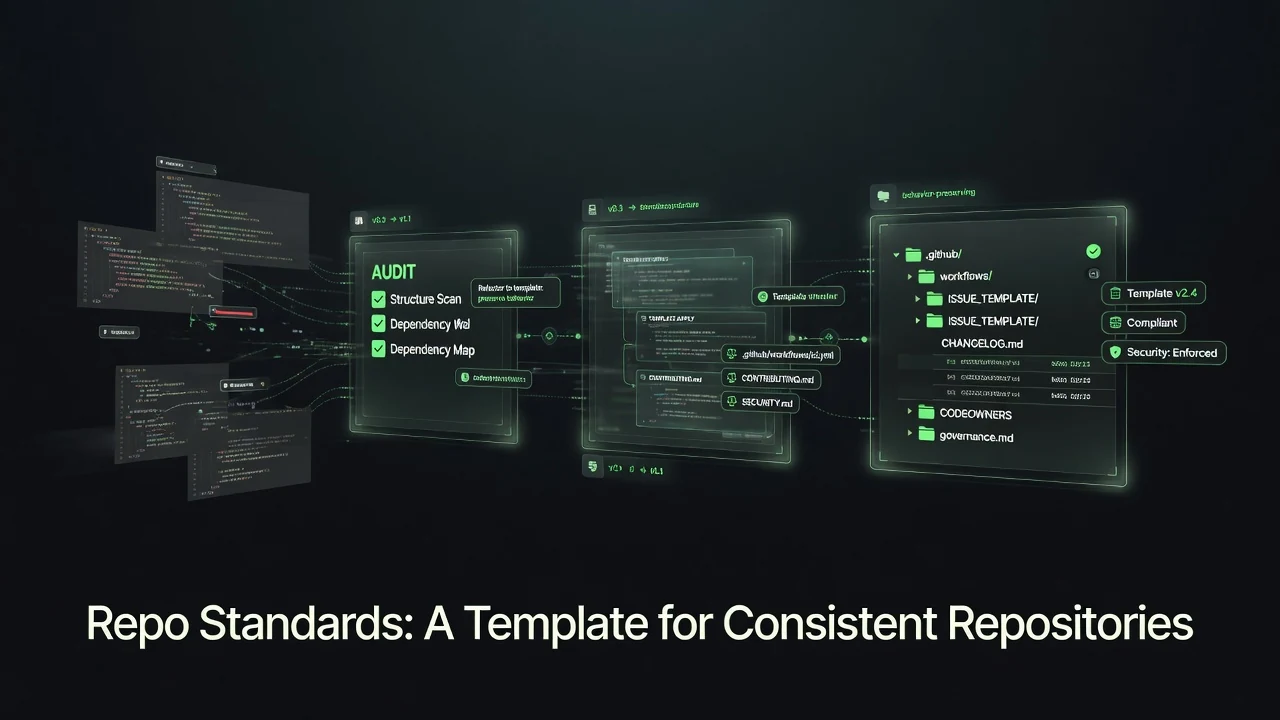
- Upgrade an existing repository
- Copy
PROMPT.mdinto a Claude Code session inside your target repo. - Claude plans the migration (Phase 0) and then executes the standardized upgrade sequence.
- You review and merge the resulting pull requests.
- Copy
- Start a new repository
- Use the repository as a GitHub template.
- Or run the upgrade prompt on a fresh clone to initialize it properly.
The process is designed to be auditable, reversible where possible, and respectful of existing code while raising the overall quality bar.
Key Takeaways
- repo-standards provides a clear, versioned definition of what a high-quality GitHub repository looks like.
- It includes powerful automation via Claude Code prompts, dramatically reducing the effort required to standardize repositories.
- Strong emphasis on security, supply-chain integrity, and sustainable maintenance practices.
- Excellent documentation and templates that can be adopted incrementally.
- Actively maintained and dogfooded by its author across multiple projects.
Conclusion
For anyone maintaining more than one or two repositories, repo-standards offers a practical and thoughtful way to raise quality, improve security, and reduce long-term maintenance burden. The combination of clear standards, high-quality templates, and AI-assisted migration makes it especially powerful in 2026.
Whether you want to bring existing projects up to a professional standard or start new ones on a solid foundation, this toolkit is worth exploring.
Repository: https://github.com/Ranzlappen/repo-standards
Sources
- repo-standards GitHub Repository (README and project structure)
- Version 3.2.0 documentation and upgrade process (May/June 2026)



Comments
Comments are powered by Giscus (GitHub Discussions).
Enable functional cookies to load comments.