
Introduction
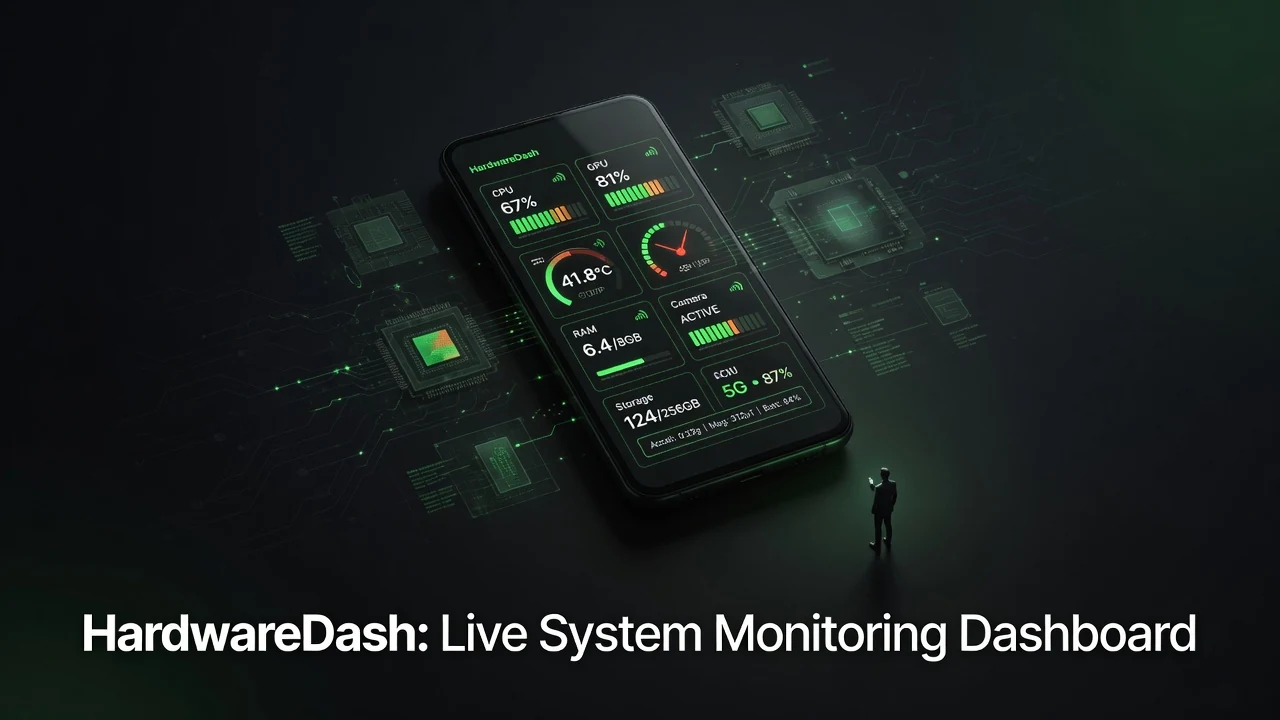
HardwareDash (also known as Gadget) is a modular Android application designed as a proof of concept for deeply exploring and automating the hardware and software layers of your device. Whether you want to monitor every sensor in real time, control radios and actuators, manage storage and apps, or build automation rules that react to hardware events, this app provides a unified, extensible interface.
The project lives in the Ranzlappen/HardwareDash repository, with active development happening on the legacy/refactor branch (claude/refactor-2026), where Phase 0 of a major modular refactor has just been completed.
Try the latest stable build: The most recent stable proof-of-concept is release v1.0.117 — grab the APK there to run it today. Everything after that release is part of the in-progress 2.0 beta, which is being rebuilt on the claude/refactor-2026 branch.
The Vision: Proof of Concept for Exploration & Automation
At its core, HardwareDash aims to give power users, developers, and tinkerers a single place to inspect, control, and automate almost every hardware surface Android exposes — and deeper system surfaces on rooted devices.
Instead of juggling dozens of separate tools, you get one coherent dashboard with sensor tiles, actuator controls, radio management, and a rule engine that lets you automate actions based on hardware state changes. It is deliberately built as a proof of concept to demonstrate what a truly integrated hardware-software automation platform on Android can look like.
Core Capabilities at a Glance
- Dashboard — Adaptive grid of live sensor and status tiles (battery, motion, ambient, GPS, etc.).
- Hardware Control — Direct access to sensors, actuators (torch, vibration), cameras, audio, and advanced radios (Wi-Fi, Bluetooth, NFC, sub-GHz, IR).
- Specialized Modules — Dedicated support for Flipper devices, storage management, app control, screen lock behavior, and bug report generation.
- Automation Engine — Rule-based automation in
core/automationwith a companion UI, allowing users to define reactions to hardware events. - Rooted Flavor Extras — Deeper diagnostics, storage, apps, lock, and bugreport surfaces available only in the rooted build, plus a bundled LSPosed module.
Everything is organized so users can explore hardware behavior interactively while also scripting automated workflows.
Modular Architecture & Dual Flavors
The app uses a clean modular monorepo structure with reusable core/* infrastructure (common utilities, domain logic, hardware registries, automation engine, design system, permissions, etc.) and focused feature/* modules (one capability per module).
Two product flavors are maintained from the same codebase:
- standard (
dev.ranzlappen.gadget) — Ships on the Play Store, works on any Android 10+ device. - rooted (
dev.ranzlappen.gadget.rooted) — Side-loaded only; unlocks deeper system surfaces and includes the LSPosed module.
A strict leak gate in CI ensures rooted-only code never accidentally enters the standard APK.
The Legacy/Refactor Branch (claude/refactor-2026)
The branch claude/refactor-2026 represents the current “legacy” state of the project during its major modular refactor. Phase 0 is complete: the full build-logic/ convention-plugin layer (8 plugins), 44 core/* / feature/* / benchmark module skeletons, and the :app migration to Kotlin DSL with updated application IDs are all in place.
This branch is the active development target right now. Phase 1 (light-preview skeleton app) is the next milestone. Contributing here helps shape the future modular foundation of HardwareDash while the main branch remains stable.
Key Takeaways
- HardwareDash is a true proof-of-concept that unifies hardware monitoring, control, and rule-based automation in one modular Android app.
- It supports both everyday devices (standard flavor) and rooted devices with deeper system access.
- The automation engine and extensive hardware coverage (including advanced radios and Flipper integration) make it uniquely powerful for exploration and scripting.
- Active development is happening on the
claude/refactor-2026legacy/refactor branch, where the new modular architecture has reached Phase 0 completion. - The project demonstrates what a comprehensive, extensible hardware-software automation platform on Android can become.
Conclusion
HardwareDash stands out as an ambitious, well-architected proof of concept that lets users truly explore and automate the hardware and software layers of their Android devices. Whether you are a developer debugging sensors, a tinkerer automating routines, or a power user wanting deeper control, this app offers a glimpse of what unified hardware automation on Android can look like.
The work happening on the legacy/refactor branch (claude/refactor-2026) is laying a solid modular foundation for the next phases. If you are interested in Android internals, automation, or rooted tooling, HardwareDash is definitely worth watching — and contributing to.
Star the repository and check out the claude/refactor-2026 branch to follow the progress:
https://github.com/Ranzlappen/HardwareDash/tree/claude/refactor-2026
Sources
- HardwareDash GitHub Repository (main README and branch information)
claude/refactor-2026branch status and Phase 0 completion notes (May 2026)- Project documentation: MASTER-PLAN.md, docs/flavors.md, and architecture ADRs
Comments
Comments are powered by Giscus (GitHub Discussions).
Enable functional cookies to load comments.