
Introduction
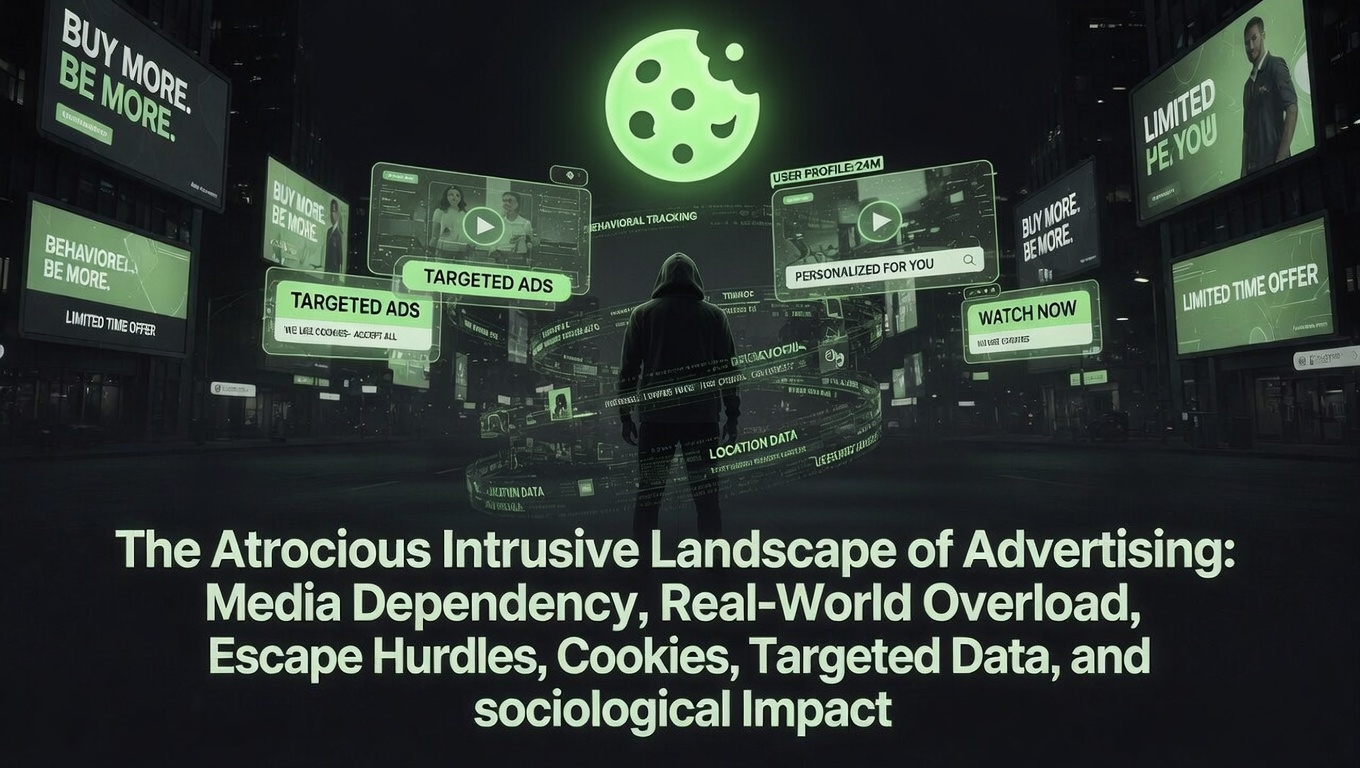
Western media’s structural failures, detailed in the prior pieces on independent journalism and partisan statistical slant, stem in large part from advertising dependency. The same economic model now drives an even more aggressive intrusion into daily life. Advertising saturates both digital platforms and physical environments with relentless intensity.[1] Consumers encounter constant interruptions, sophisticated tracking mechanisms, and societal conditioning that normalizes overconsumption. Escaping this system demands deliberate, ongoing effort. At the same time, the model generates disposable corporate revenue for products that could compete on intrinsic value alone. This article examines the full scope of the problem, its trajectories, avoidance barriers, the mechanics of cookies and targeted data exploitation, the sociological forces at play, and the direct cost to users.
The Expanding Advertising Landscape in Media and the Real World
Digital media delivers the most immediate and personalized intrusion. Social feeds, streaming services, news sites, and apps insert repetitive video, banner, and native ads into every scroll or pause. Physical advertising has kept pace and evolved in tandem. Billboards, transit wraps, digital out-of-home screens, and even store interiors now deploy programmatic targeting and contextual relevance. Global ad spend surpassed one trillion dollars in 2024 and continues its upward climb, with digital and out-of-home formats claiming growing shares.[2] The result is an environment where advertising no longer feels like a side element but the dominant layer overlaying content and public space alike.
Trajectories of Intrusion and Escalation
The trajectory shows clear escalation on both fronts. Traditional media once confined ads to predictable breaks or side columns. Digital platforms eliminated those boundaries through algorithmic insertion, infinite scrolling, and auto-play. Real-world advertising shifted from static signage to data-driven, location-triggered displays that adapt in real time. This dual-front expansion creates a seamless attention economy optimized for frequency and engagement metrics rather than relevance or user benefit. The parallel development in media and physical spaces reinforces the sense of inescapability.
The Difficulty and Hurdles to Escape or Avoid Advertising
Avoidance now requires constant vigilance and technical workarounds. Browser extensions can block many online ads, yet publishers detect them and respond with paywalls, degraded experiences, or server-side ad delivery that circumvents client-side blockers. Streaming services have introduced anti-ad-block measures and increased ad loads even on paid tiers. In physical environments, escape is practically impossible without avoiding urban centers, public transport, or commercial areas entirely. Consumers routinely report ad fatigue: two-thirds describe ads as intrusive, excessive, or irrelevant.[3][4] The effort needed to curate even a partially ad-free existence underscores how deeply the system has embedded itself into everyday routines.[8]
How Cookies Enable Targeted Advertising
Third-party cookies remain the foundational technology for cross-site tracking despite repeated privacy regulation attempts. They allow advertisers to follow users across unrelated domains, compiling detailed behavioral profiles from browsing history, search patterns, and purchase signals. Google’s 2025 decision to retain user-controlled cookie options in Chrome, rather than full deprecation, illustrates the persistence of these mechanisms.[5] Alternatives such as first-party data collection and contextual targeting have emerged, but cookie-based systems continue to dominate because they deliver measurable return on investment.
Targeted Ads Exploiting Intrusively Collected User Data and Research Status
A critical subsection concerns targeted ads that rely on intrusively collected user data. Research from 2025-2026 consistently shows these ads achieve higher short-term click-through rates yet provoke stronger negative reactions when users perceive them as surveillance. Privacy enforcement actions have increased, with regulators issuing fines for opaque consent practices. Studies confirm that repeated exposure to retargeted ads raises feelings of being watched (79 percent of respondents in recent surveys) and erodes overall trust in both brands and platforms.[4] The research status remains clear: while personalization drives immediate engagement metrics, it accelerates privacy backlash and long-term user disengagement. Cookie-dependent targeting persists precisely because it converts data into revenue, sustaining the arms race between trackers and privacy tools.
The Unfortunate Sociological Impact and Influence That Makes Advertising Work
Advertising succeeds by actively shaping desires rather than simply informing choices. It cultivates materialism, ties self-worth to consumption, and fuels both impulse buying and conspicuous display. Longitudinal studies across European countries link rising per-capita ad expenditure to subsequent measurable declines in national life satisfaction.[6] Cross-national analyses show that higher advertising exposure correlates with lower reported happiness even after controlling for GDP, as aspirational standards outpace attainable reality.[7] This sociological conditioning creates the very demand that justifies ever-larger advertising budgets.
Disposable Revenue, Overpricing, and Media Funding at User Expense
The same conditioning generates the disposable revenue that allows companies to advertise heavily in the first place. When a product’s margins comfortably support massive promotional spending, the core offering is typically overpriced relative to its production, distribution, and genuine value. Advertising simultaneously funds media content while degrading user convenience through interruptions, paywalls, and lowered experience quality. Audiences therefore pay twice: once through their attention and data, and again through reduced wellbeing and inflated product prices. This cycle mirrors the broader trust erosion documented in the preceding articles on media failures and statistical manipulation.
Key Takeaways
- Advertising intrusion now spans digital media and physical spaces with parallel escalation, leaving 91 percent of consumers reporting higher intrusiveness than in prior years.[4]
- Cookies and related trackers sustain targeted advertising despite regulatory pressure, with research confirming both short-term effectiveness and long-term backlash.
- Sociological effects include heightened materialism, impulse consumption, and documented drops in life satisfaction directly tied to ad exposure levels.
- Media outlets remain tethered to ad revenue, prioritizing engagement metrics over user experience and thereby accelerating audience distrust.
- Substantial advertising budgets serve as a practical indicator of overpricing, as products with genuine merit should not require constant external persuasion.
Conclusion
The advertising landscape exposes a fundamental imbalance. Companies generate enough surplus revenue to bombard consumers across every channel and environment, while users must invest disproportionate time and technical effort simply to reclaim basic attention and privacy. Cookies and data practices amplify the intrusion. Sociological conditioning ensures the cycle self-perpetuates. Media dependency on these dollars further subsidizes content at the direct expense of convenience and trust. Reducing reliance on intrusive monetization in favor of direct value exchange would restore balance and compel products to compete on merit rather than marketing volume.
Sources
- Clutch (2026). Ad Fatigue is Real: Why Advertising Strategies are Failing.
- Deloitte (2025). Digital Media Trends.
- Advertising Week. Brands Must Face up to the Truth of Ad Fatigue.
- HubSpot via Tipsonblogging (2026). 14 Ad Fatigue Statistics.
- Ethyca (2026). Third-Party Cookie Deprecation: The 2026 Guide.
- CEPR (2019, updated 2025). Advertising as a Major Source of Human Dissatisfaction.
- Griffith et al., Journal of International Business Studies. "Understanding the Relationship between Advertising Spending and Happiness at the Country Level."
- Blockthrough. How Bad Ad Experiences Affect UX and Revenue for Publishers.
Comments
Comments are powered by Giscus (GitHub Discussions).
Enable functional cookies to load comments.