
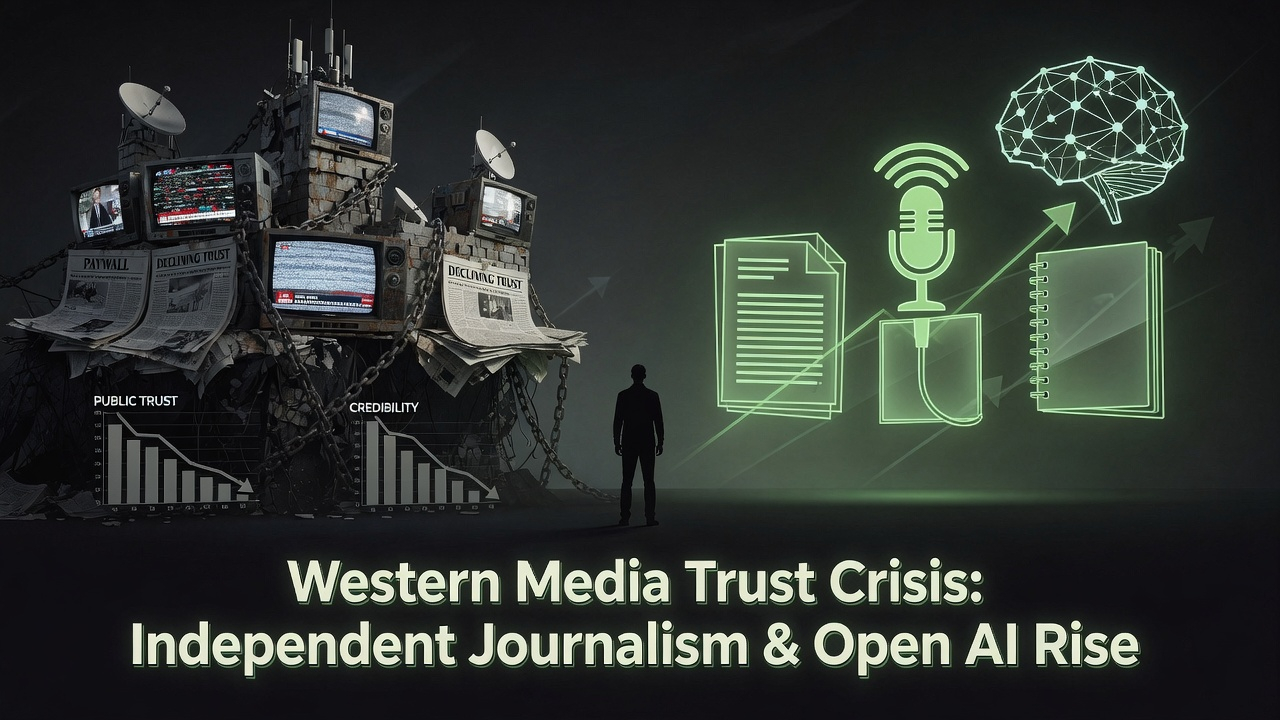
Western Media Trust Crisis: Independent Journalism & Open AI Rise
This analysis focuses exclusively on media ecosystems in Western democracies the United States and Europe where corporate and public-funded outlets operate in relatively free but commercially and politically pressured environments. These systems differ markedly from state-controlled or suppressed media in non-Western contexts. Public trust in legacy Western media has collapsed. Reuters Institute’s Digital News Report 2025 shows overall trust stable at 40% globally, but with sharp Western declines: US at 30%, Germany at 45% (down 15 percentage points since 2015), and UK at 35% (down 16 points).[1] Concern over distinguishing truth from falsehood online reaches 73% in the US versus 46% in Western Europe.[1] These figures reflect shared structural failures, paywalls, advertising dependency, user-data exploitation, ideological framing, statistical manipulation, fluff, and suppressed feedbackdriving audiences to independents while highlighting the need for minimally restricted AI.
US vs Europe Data Snapshot
| Country/Region | Trust in News (%) | Change Since 2015 | Fake News Concern (%) |
|---|---|---|---|
| United States | 30 | Stable (low) | 73 |
| Germany | 45 | -15pp | ~46 (Western Europe) |
| United Kingdom | 35 | -16pp | ~46 (Western Europe) |
| Western Europe | 40–50 (avg) | Declining | 46 |
Source: Reuters Institute Digital News Report 2025[1]
Corporate and Public Media's Structural and Editorial Failures Across the West
Revenue pressures dominate both corporate and publicly funded models. In the US, paywalls affect 74% of adults frequently with low multi-subscription rates.[1] Europe shows parallel stagnation despite public funding for broadcasters. Advertising dependency fuels clickbait on both sides of the Atlantic. User-data exploitation persists via trackers, often with opaque consent in the GDPR-era EU.
Publicly or partially government-funded outlets face additional, distinct problems. In Germany, ARD and ZDF operate under compulsory household financing via the Rundfunkbeitrag (broadcasting fee, currently €18.36/month), which every household must pay regardless of consumption.[2] Critics highlight inflated staff levels ARD alone employs over 22,600 people with bureaucracy mirroring public-sector bloat, leading to inefficiency and calls for leaner operations.[3] Ongoing fee debates include 2025–2026 proposals for increases (to €18.64 from 2027) that were frozen or challenged in court, alongside accusations of bias tied to political influence and lack of transparency in spending.[2] Similar issues appear across Europe’s public broadcasters, where forced financing reduces direct accountability to audiences.
Editorial flaws are consistent. Outlets embed utopian ideological frames climate, social policy, economics over raw evidence. Reporting lacks conciseness, padded with opinion. Statistics are selectively framed. Transparency falters: corrections bury deep, criticism faces algorithmic demotion or moderated comments.
Legacy TV's Structural Limitations in Western Media
Traditional broadcast TV exacerbates many of these failures, particularly in public-funded systems. Unlike digital platforms, TV remains largely one-way: viewers cannot provide live feedback, comment in real time, or hold producers accountable during broadcasts. This lack of interactivity contrasts sharply with independent newsletters or podcasts, where audience input is immediate and public. In Germany and across Europe, linear TV channels (many operated by ARD/ZDF) face declining audiences as viewers shift online, yet reforms to close select channels (e.g., ARD alpha, tagesschau24 by end-2026) come slowly.[4] The result is reduced responsiveness and a further disconnect from digital-native audiences.
The Self-Reinforcing Link to Educational Decline in Western Societies
Corporate and public media flaws fuel and are fueled by weakening media literacy. The News Literacy Project’s November 2025 US teen report found 84% hold negative views (“biased,” “boring,” or “bad”), with 45% believing journalists harm democracy and 69% perceiving intentional bias.[5] Reuters 2025 notes similar avoidance trends across Europe, where social media fills gaps left by declining traditional engagement. EU media literacy initiatives exist but remain limited, with educators allocating minimal hours amid competing demands.[6] This cycle reduces demand for critical-thinking education while leaving audiences vulnerable to spin evident in both US partisan divides and European public-broadcaster skepticism.
Independent Journalism's Rapid Ascent and Accountability Model
Independent creators fill the vacuum. Substack surpassed 5 million paid subscriptions by early 2025, with growth accelerating in both US and European markets through direct reader funding over ads.[7] A Change Research poll (December 2025) found 34% of Americans trust independent/online journalists most nearly triple national outlets mirroring rising European reliance on newsletters and podcasts.[8] These models enforce accountability: readers pay for value, feedback is public, bias is transparent and market-tested. Conciseness, source transparency, and responsiveness replace institutional opacity.
AI Development with Minimal Guardrails: The Essential Counterbalance
Fragmented Western information ecosystems demand AI prioritizing evidence over curated safety. Heavy guardrails in leading models risk echoing legacy media biases. Minimally restricted development pairs naturally with independent journalism.
Recent 2025–2026 studies compare:
-
ChatGPT (OpenAI) and Claude (Anthropic) use extensive filters, showing consistent left-leaning tendencies on social/economic issues per IEEE Access 2025 and Anthropic’s November 2025 research.[9][10] Refusals limit analysis.
-
Gemini (Google) adopts centrist framing but retains corporate-aligned guardrails, with high refusal rates per Brookings (October 2025).[11]
-
Grok (xAI) employs lighter restrictions. Evaluations rank it among the lowest in detectable bias and highest in responsiveness, with minimal refusals.[12] It surfaces evidence-based views without ideological defaults.
Minimal guardrails block illegal content but avoid external shaping distorting Western media narratives. In an era of filtered reporting, such AI delivers unvarnished data across US and European perspectives.
Key Takeaways
- Western media trust is critically low: US 30%, Germany 45% (-15pp), UK 35% (-16pp) per Reuters 2025, driven by paywalls, data exploitation, compulsory fees, staff bloat, and opacity.
- Public broadcasters add unique issues: Germany’s ARD/ZDF compulsory Rundfunkbeitrag and large staffing levels fuel inefficiency and bias debates.
- Legacy TV’s one-way nature limits live feedback, widening the gap with digital independents.
- These failures correlate with teen media illiteracy (84% negative US views) and parallel European trends.
- Independent journalism leads trust via direct accountability; minimally restricted AI like Grok supports unbiased inquiry.
- Transparent, feedback-driven systems in journalism and AI are essential for Western democratic discourse.
Conclusion
Western corporate and public media’s monetization-over-mission and forced-financing models have accelerated decline on both sides of the Atlantic, degrading critical thinking in education. Independent journalism provides a reader-funded corrective, while minimally guarded AI offers technological reinforcement. Prioritizing evidence, transparency, and minimal external influence is foundational for informed citizenship in 2026 and beyond.
Sources
- Reuters Institute (2025). Digital News Report 2025.
- IAmExpat (2026). German TV "tax" likely to increase from 2027.
- Xpert.digital (2026). Why public broadcasting is in an unprecedented crisis of confidence.
- Broadband TV News (2026). ARD and ZDF to close linear TV channels under reform treaty.
- News Literacy Project (2025). "Biased, Boring and Bad: Unpacking Perceptions of News Media Among U.S. Teens."
- European Commission (2026). Media Literacy.
- Change Research (2025). "Americans Turn to Independent Voices."
- Change Research (2025). "Americans Turn to Independent Voices" (Trust Poll Data).
- IEEE Access (2025). "Political Bias in Large Language Models: Comparative Analysis."
- Anthropic (2025). Political Even-Handedness Research (Nov 2025).
- Brookings Institution (2025). "Is the Politicization of Generative AI Inevitable?"
- AIonX (2025). AI Chatbot Bias Comparison Study.

Comments
Comments are powered by Giscus (GitHub Discussions).
Enable functional cookies to load comments.