
Introduction
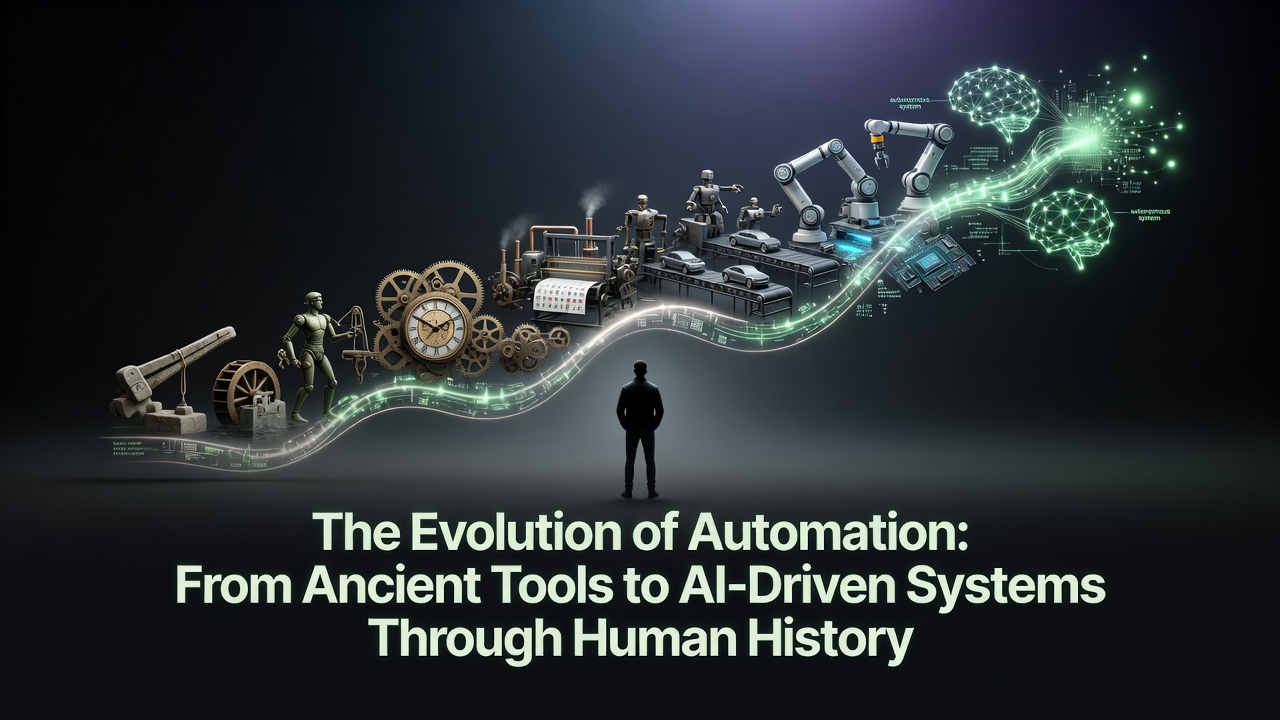
The concept of automation has shaped human progress for millennia. It represents humanity’s enduring drive to reduce manual labor, increase efficiency, and extend capabilities through machines that operate with minimal or no human intervention. From prehistoric levers and water wheels to today’s AI systems that make decisions and learn autonomously, automation has evolved in parallel with technology, society, and economic needs. This journey reflects not only technological innovation but also shifts in how humans view work, creativity, and control.
Ancient Origins: Simple Machines and Automata
Automation’s roots trace back over 5,000 years. Around 3500 BCE, Mesopotamians developed the wheel and axle, enabling carts and pottery wheels that reduced manual effort.[1] Ancient civilizations created early powered mechanisms: Chinese trip-hammers powered by water around 2000 BCE automated grain processing and forging.[2] Water wheels and windmills performed repetitive tasks such as irrigation and milling without constant human input.
Philosophers and inventors imagined more advanced forms. Greek myths described Hephaestus forging metal automata as servants.[5] By 150 BCE, the Hydraulis, a water-powered organ, demonstrated programmable mechanical action. In ancient Egypt, Greece, and Rome, engineers built mechanical statues and devices that moved autonomously through hidden mechanisms, serving religious, entertainment, or practical purposes.[5] These early automata embodied the concept of machines acting of their own will.
Medieval and Renaissance Advances
The Middle Ages and Islamic Golden Age advanced mechanical ingenuity. Windmills with automatic sail-turning mechanisms spread across Europe and the Middle East. The mechanical clock, developed around 1335 in Europe, used weights and gears for self-regulating timekeeping.[1] Books such as the 9th-century “Book of Ingenious Devices” cataloged sophisticated machines powered by water, steam, or weights.[5]
During the Renaissance, Leonardo da Vinci sketched designs for self-propelled carts and mechanical knights around 1495.[2] These conceptual automata pushed the boundary between tool and independent machine, laying groundwork for programmable systems.
The Industrial Revolution: Mechanization Takes Hold
The late 18th and early 19th centuries marked a pivotal shift. James Watt’s improved steam engine in 1765 powered factories and enabled mechanized production.[2] The Jacquard loom (1801) used punched cards to program complex textile patterns, introducing the idea of programmable machines.[3] Oliver Evans created the first fully automated flour mill in 1785, achieving continuous production without human intervention.[1] These developments replaced human and animal power with mechanical force on a massive scale, birthing the factory system and transforming economies.
Early 20th Century: Assembly Lines and the Birth of Modern Automation
Henry Ford’s moving assembly line in 1913 revolutionized manufacturing. It reduced Model T production time from 12 hours to 90 minutes through synchronized, repetitive tasks.[3][4] Electrification and standardization further scaled output. World War II accelerated innovation, with automated production for military equipment. The term “automation” itself emerged in 1946 when Delmar S. Harder at Ford used it to describe the need for more automatic handling in production.[2]
Mid-20th Century: Computers, Robots, and the Term Automation
The 1950s and 1960s integrated electronics and computing. George Devol’s Unimate (patented 1954, installed 1961 at General Motors) became the first industrial robot, performing die-casting and welding with precision.[6][7] Charles Babbage’s earlier analytical engine concepts found realization in electronic computers like ENIAC (1946).[2] Programmable logic controllers (PLCs) in the 1960s enabled reliable industrial control. The Stanford Arm (1969) introduced electrically powered, computer-controlled robotic arms with greater dexterity.[6]
The Digital Age and Rise of Robotics
From the 1970s onward, microprocessors and integrated circuits miniaturized and accelerated automation.[8] Industrial robots from companies like ABB, KUKA, and FANUC spread globally.[7] The 1980s and 1990s brought computer numerical control (CNC) machines, vision systems, and force sensors. Robotic process automation (RPA) later extended automation to software tasks such as data entry. Automation moved beyond factories into logistics, agriculture, and services.
The AI Era: Intelligent Automation Today
The 21st century fused automation with artificial intelligence. Machine learning enables systems to adapt, predict, and optimize without explicit programming. Collaborative robots (cobots) work safely alongside humans. AI-driven platforms now automate complex decision-making in finance, healthcare, logistics, and creative fields. As of 2026, automation encompasses edge computing, quantum interfaces, and autonomous systems across industries. The focus has shifted from mere mechanization to intelligent, self-improving processes that augment human capabilities.
Key Takeaways
- Automation began with prehistoric simple machines and ancient automata designed to reduce labor and perform repetitive tasks.
- The Industrial Revolution transformed the concept through steam power, programmable looms, and factories, replacing human muscle with mechanical force.
- 20th-century milestones including assembly lines, computers, and the first industrial robots formalized modern automation and coined the term itself.
- Digital and AI eras have made automation adaptive, intelligent, and ubiquitous, extending far beyond physical manufacturing.
- Throughout history, automation has driven productivity gains while raising recurring questions about labor displacement and human purpose.
Conclusion
The concept of automation has evolved from humanity’s earliest efforts to augment physical strength with tools to today’s sophisticated AI systems that replicate and exceed cognitive functions. Each era built upon the last, driven by the same core impulse: to achieve more with less direct human effort. As automation continues to advance, it challenges societies to balance efficiency with equity, creativity with control, and technological progress with human values. Understanding this long arc equips us to navigate the next phase responsibly.
Sources
- Progressive Automations (2022, updated 2025). Timeline History of Automation.
- Britannica (2026). Automation Technology, Types, Rise, History, and Examples.
- CubeFabs (2024). A Brief History of Automation in Manufacturing.
- World Economic Forum (2020). A Short History of Jobs and Automation.
- MIT Press Reader (2021). The Ancient History of Intelligent Machines.
- UTI.edu (2025). The Definitive Timeline of Robotics History.
- Autodesk (2022). History of Industrial Robots.
- Capow Energy (2024). The Evolution of Automation From the Industrial Age.
Comments
Comments are powered by Giscus (GitHub Discussions).
Enable functional cookies to load comments.